Monday, 8 October 2012

Trip Report: Day trip from Paris to Provins

If you're looking a place to do as a day trip excursion from Paris, and you have an interest in things medieval, then Provins might be the place for you. If you want to know what to expect, here is our trip report from Provins....

A while ago we headed Southeast to the Medieval town of Provins, a UNESCO world heritage site. We caught the train from Gare de l’Est (the East Train Station). We were running a little late (or at least close to time) and had some fun trying to find the right ticket machine to buy tickets. It was interesting to see how far we had come since our first visit to Gare de l’Est when we went to Chartres. We had much less trouble this time and caught our train with time to spare. The trip is about an hour or so by train.

Provins is not one of the more well-known tourist attractions, although we really enjoyed it, and it means that there were a lot less English tourists. The town is more set up for French tourists, which meant that there was a lot of French spoken, but not a lot of English. We got by just fine, which was encouraging. We arrived just after lunch time and were feeling pretty hungry, so we walked into the main part of town and found a Patisserie. We picked up a few things from a local bakery and found a grassy spot behind a church to enjoy the afternoon sun. It turned out the church we were sitting behind was Saint-Ayoul Church and was originally built in the 12 Century with major upgrades in the 16th Century.

The church near which we ate:


After lunch we began to wander around the town. It is split into two parts: the lower town and the upper town. We were in the lower town to start with and just followed our noses for a bit. We found a bell tower. This was the bell tower for the church and cloister of Notre Dame du Val which was destroyed during the French Revolution.


At the foot of the bell tower was a map which had a heritage walk which we decided to follow. This took us up the road a little further to the Sainte Croix church. The church is closed to visitors and looked in pretty bad repair. Like Saint Ayoul, it was originally built in the 12thCentury and restored in the 16th.

We continued to follow the path up towards the upper town and came across what looked like a church that was open. There were steps leading down to the crypt with an open sign on the door which said souterrain– not really sure what we were going to we went in and purchased a ‘Pass Provins’ for 9 Euro (much cheaper than the major attractions in Paris) which let us in to a vaulted basement. It was quite dark and it appeared to be just a large basement area, albeit with a cool ceiling. There was a French speaking tour of the basement being undertaken in the corner but we ignored it. However the guide invited us to join them for the ‘tour’. He took us through a grate we hadn’t really seen, and into a massive underground cave structure. Provins was a major wool production centre and in the 18th and 19th Centuries the ground was mined for a type of clay that was used to degrease the wool. It was quite amazing to see. There were all sorts of rooms which had been constructed. There was also graffiti from the 18th and 19th century.


We came back into the light and explored the rest of the upper town:

The three major features are Caesar’s Tower, The Saint-Quiriace Collegiate Church and the ramparts. On the way up we visited the Provins museum housed in one of the oldest buildings in the city – a Roman House from the 12


Caesar’s Tower is a traditional looking castle structure that towers over the city. Apparently it was originally built as a defensive structure in the 12th Century, but it wasn’t particularly useful for defense so over time it was converted to use as a prison and a watch tower. It was great to be able to walk all over the structure and it had great views all over the city.


Next was The Saint-Quiriace Collegiate Church, just down the road from the Tower. The church was an example of a whole lot of things that were never finished. It was begun in around 1176 but they ran out of funds to complete it. It was supposed to reach almost over to Ceasar Tower, but never did. According to a plaque on the side of the church, if we interpreted it correctly, Joan of Arc attended a service here at one stage.

We decided that we would do the rampart walk. About a third of the upper town has the ramparts surrounding it. You head out one gate and go out into the country side – it was nice to spend some time just looking at empty fields after the huge density of Paris – we then went back in and headed around the walls. They are immense when seen from their base.


Once we had finished this, we did (as we often do) the tourist office almost last and watched a video about the town, again all in French. We then headed back into the city. On our way through we stopped at the Tithe Barn where the Friars of Champagne held a covered market in the 13th Century. There is a reasonably cheesy display of people plying their trade, but the building was cool. Most helpfully the attendant at the entrance was able to give us some directions about where to eat. He confirmed Gary’s maxim – to always eat away from the tourist spots. He gave us the name of a couple of places in the lower town where he would eat. Given that we would arrive home late we thought it was good to eat in Provins.

We took one of his suggestions and had a great meal as the sun set dining out on the street. It was a really nice way to finish a great day.

For details on travel to Provins, and what to see and do, check out www.beyond-paris.com/provins. 


Friday, 5 October 2012

Paris off the beaten track: Where are Les Halles

Paris is full of major must see monuments, sights, and museums. However, hidden within the small side streets of Paris and down some of the less traveled boulevards there are some hidden gems; secret sights that are off the beaten track but are well worth visiting. Not only will they give you some photos of Paris that are different from your friends and family, but they will also give you an insight into the real Paris of today, and the Paris of yesterday.

Last weekend the "off the beaten track" location was the Le Jardin d'Agronomie Tropicale in Nogent-sur-Marne. If you are visiting the tropical garden, visiting the Pavillon Baltard is an interesting side trip, although probably not worth the trip just by itself.

First, some history: right in the middle of Paris is a large shopping center called Forum Les Halles - where the major metro stations Chatelet and Les Halles come together.

Photo Credit: Roger Henard

The Les Halles area was the traditional central market area of Paris. Massive halls, known as Les Halles, were errected from the back of the old chamber of commerce beside the Eglise Saint-Eustache. Les Halles was described by Emile Zola as the "Belly of Paris". Zola described a busy marketplace; Les Halles was a collection of large warehouses made of blue and green steel girders with glass windows.

Les Halles suffered from the new economy in the 1950's - 1970's and gradually became in need of significant repair, further reducing its patronage. Eventually, in 1971, Les Halles was dismantled and all of the halls were removed.


However, one hall remains - the Pavilion Baltard. Initially constructed in Les Halles in 1857, it was dismantled and moved to Nogent-sur-Marne where it was reconstructed in 1976.  Named after the designer of Les Halles, Victor Baltard, Pavilion Baltard was Pavillion Number 8 at Les Halles and was the home of the eggs and poultry market.


Now the pavilion is a space for concerts and exhibitions, so unless you are attending something specific you aren't able to enter the pavilion  but its easy to view from the outside.


Although, it is a nice little detour to see a part of Paris' history if you are out visiting the Le Jardin d'Agronomie Tropicale. Its probably not worth the trip on its own (unless you are a huge fan of the history of Les Halles), but its nice to know that these little pieces of history still exist.


How to get there: Take the RER A line to Nogent-sur-Marne. This is in the 3rd zone, so if you are travelling from Paris you will need to buy a specific ticket for this (ie the Paris Metro T+ ticket won't let you out). Take exit #3 from the Nogent-sur-Marne RER station and follow the signs to the Pavillon Baltard. If you are visiting Le Jardin d'Agronomie Tropicale walk back to the RER station, walk past entrance #1 to the RER station, turn right past the RER station, cross the interection, turn right, then walk down Avenue Victor Hugo. Pavillon Baltard is on Avenue Victor Hugo.


For other activities that are off the beaten track and to get a taste of the real France, explore options for day trips from Paris using public transport on www.beyond-paris.com.


Keep up to date with upcoming "off the beaten track" locations, and ideas for day trips from Paris on our Facebook page and our Twitter account.

Wednesday, 3 October 2012

Its great to be in Paris this weekend because.....

Not only is it free Museum day on Sunday, but it is also Nuit Blanche on Saturday.

If you haven't come across Nuit Blanche before, it is (for me) one of the highlights of the year in Paris.

Nuit Blanche (which literally means White Night) is an all night art and performance event. It starts at 7pm on the Saturday and runs right through the night to 7am on the Sunday. All over the city (normally clustered around specific areas) there are art installations. And it is art in its widest context - from large orange yetti's in a luminous blue room, to all night classical piano concerts, through sculpture, audio-video, and somethings that are just weird (like last year where you could stand on a strip in front of a wall, you would be projected up on a screen in a farmyard setting - although it wasn't you exactly, you got transformed into a pig, or a horse, or a refrigerator, or a yellow VW Beetle, and these things move as you do around the strip).

The official site for the Paris Nuit Blanche 2012 is http://nuitblanche.paris.fr/ and there is also a free smartphone app for Andriod and Iphone.

Some of my photos from the 2011 Nuit Blanche are below.


Friday, 28 September 2012

Paris off the beaten track: A tropical garden lost in the past

Paris is full of major must see monuments, sights, and museums. However, hidden within the small side streets of Paris and down some of the less traveled boulevards there are some hidden gems; secret sights that are off the beaten track but are well worth visiting. Not only will they give you some photos of Paris that are different from your friends and family, but they will also give you an insight into the real Paris of today, and the Paris of yesterday.

This weekend's off the beaten track site is Le Jardin d'Agronomie Tropicale: The Garden of Tropical Agriculture. Credit for this off the beaten track post goes to to Kerouac2 whose awesome photo essay on the Any Port in a Storm website introduced me onto this garden. Kerouac2 called it the "Abandoned Garden of Desolation" which is a pretty good description.

The entrance to the Jardin

Visit this garden and the chances are you will be alone (or close to alone - when I went there was a small French tour group being guided around and maybe 3 other people) with the ghosts of France past.

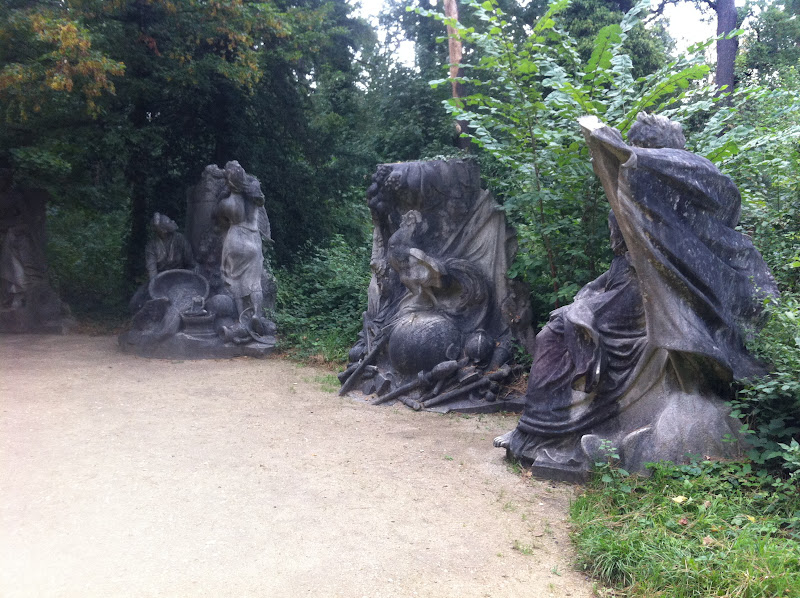
Statues from the 1907 colonial exhibition
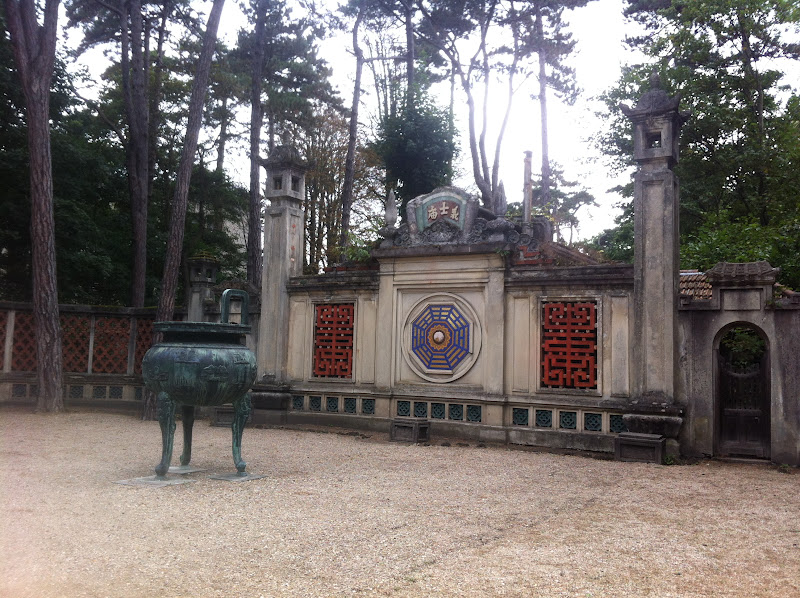
Memories of the Indochinese colony
Many of these statues have seen better days
The garden, at the North-east corner of the Bois de Vincennes has a fascinating history and makes for a unique outing from the busyness of the central Paris.

Dilapidated statues in the park
Originally, in 1899 the park was developed as a test garden for scientific exploration on tropical plants from French colonies. The aim was to improve production of products such as coffee, rubber and banana's.

Some of the old glasshouses

In 1907 the park became the site of the colonial exhibition. Six 'villages' were developed with the monuments representing the French colonies of the time. These were Indochina, Madagascar, Congo, Sudan, Tunisia and Morocco, Not only were monuments and buildings set up, but people from the colonies were bought to Paris to live in the villages, making them a live display, or what has been called a 'human zoo'. RFI France have an interesting article on the 1097 colonial exhibition in English.

Walking through the Jardin

After the exhibition was finished, the park was later used as a hospital for French colonial troops from the first world war, and was the site of the first mosque in Paris. This was removed when the new mosque was built in the 5th arrondisement. Also erected were memorials to the colonial troops who fought and died for France in the war.

Memorial for the troops colonial troops from Cambodia
and Laos who died fighting for France
Memorial for the colonial soldiers from Madagascar
Memorial for the Indochinese who died fighting for France
The park gradually fell into disrepair leaving a desolate, yet amazing collection of memorials and buildings. It is what French historian Pascal Blanchard referred to as "the junkyard of French colonial history....the memory of France's relations to its colonies over the last century is concentrated here".

One of the abandoned pavilions
Another deserted pavilion
However, it is the junkyard feel and overgrown nature of the park which gives it its charm and makes it so unique. Come around a bend in a path and you may come across a Chinese pagoda, or a unique disused building, or a Cambodian temple shaped monument which disappear quickly as you pass, and you are never quite sure what you will discover around the next overgrown corner.

The restored Indochina pavilion
Part of the remains of the Indochina village
Another view of the Indochina village
Recent years has seen money put into the redevelopment of the park. The paths have been cleared and delineated and the dilapidated buildings have been fenced off. The Indochina pavilion has been renovated and is home to the French Institute of Agricultural Research for countries of the South (CIRAD) and also houses an exhibition of photos which appear to be from former French colonial people (it wasn't open when I visited). Other buildings have suffered greatly. The Congo pavilion, for example, was destroyed by fire in 2004. The restoration appears to be ongoing, however running behind schedule. There is also an interesting collection of wooden sculpture which has been set up in the park designed by Johann le Guillerm.

The burnt out Congo Pavilion
One of Johann le Guillerm's sculptures
Another of Johann le Guillerm's sculptures
Johann le Guillerm's incorporated into one of the dilapidated pavilions
Today the park is great for a stroll. It is a surreal experience with the emptiness of the park and the memorials and buildings from different places and different times. Suitable for taking kids; the derelict buildings are fenced off - but there is also water around, so you will need to keep an eye on them. It will probably take you an hour or two to explore the park.

A view across the park 
One of the Indochinese bridges with its pond and waterfall
The garden is Nogent-sur-Marne. While you are there, you could also look at the Pavillon Baltard - Link to come.

How to get there: Take the RER A line to Nogent-sur-Marne. This is in the 3rd zone, so if you are travelling from Paris you will need to buy a specific ticket for this (ie the Paris Metro T+ ticket won't let you out). Take exit #1 from the Nogent-sue_Marne RER station and the direction to the park is well sign-posted from outside the door - follow the signs to Jardin Tropical. It is left from the station, take the first right, and follow this to the end. It is a 5 minute walk from the RER station to the garden.

Exit #1 from the RER
You can see the first sign to the Jardin through the door
For other activities that are off the beaten track and to get a taste of the real France, explore options for day trips from Paris using public transport on www.beyond-paris.com.

Keep up to date with upcoming "off the beaten track" locations, and ideas for day trips from Paris on our Facebook page and our Twitter account.

A final view of the remains of the Indochinese village

Tuesday, 25 September 2012

Train Tip - Buying train tickets at the station

Whichever station you head to for your day trip from Paris you have a couple of options.

Of course, you can buy your tickets in advance from an SNCF Boutique. But, if you are like us, and you don't decide until the day you are going to leave that you are going somewhere it is just as easy to buy the tickets at the train station.

In each train station there are two options: either buying tickets at the counter, or using the automated machines.

Buying tickets at the counter is pretty easy, especially if you have written down where you want to go. Most of the tellers speak some English, and its pretty obvious what you want to do. Every time I have need to use a counter the staff have been very helpful. However, there are often very long lines to get to the counter. And, as most people who are using them are either changing an existing booking or there is a reason they aren't using automated teller machines, it can take a long time for the queue to move.

Important: to use the yellow machines you need to have a "chip" credit card. If you don't, you can't use these machines and will need to buy your ticket from the ticket counter.

One of the many collections of yellow ticket machines


The automated teller machines are yellow (the green ones are for RER and Metro tickets only) and are touch screen and you need a credit card with a chip to use them (they do not take cash).


The main screen of the automated ticket machine
Select your language in the top left of the main screen


Don't panic if you don't speak French, you can select the option of English, German, Italian, Spanish, or Dutch. On the assumption that you are reading this blog in English, I have selected English. From here you just need to follow the onscreen instructions to buy your ticket.


Options (in English) on the main screen


Firstly, you need to decide when you want to go - either immediate departure (which will give you the option to pick any of the next three or four trains heading to the destination you select) or a later train. You also have the option to collect electronic tickets using the "File and Electronic Ticket Collection" option. If you have a chip credit card you have the option of booking your ticket online and collecting them from these machines at the station. You cannot use American Express for this option and it is only available in France and Luxembourg however, you can pick up tickets for any station in Europe as long as you collect them in France.


Options for immediate departure from Gare du Nord

If you want to head off for your day trip now (or very soon), select "Immediate Departure". If you are in a major train station the machine will assume that you want a ticket from that station. In this example I am Gare du Nord and the machine will insert this for me and give me the most popular destinations from this station. If you are in a station in an outlying area (for example, Chantilly) you may need to enter the station you are leaving from first.


Next, select where you want to go. In this case, Lille. If the destination you want is not listed you can select "other destinations" on the bottom right - this will allow you to enter your destination on a keypad. Normally you only need to enter three letters before the machine will give you the list of possible destinations. The keyboard will remove letters that you can't use for a place name to ensure you spell it correctly.

List of options for Lille - note some are Lille Europe
and some are Lille Flanders. Its good to know which you need

Once you have selected the destination you want the machine will display the upcoming train options, departure time, arrival time, total travel time (including changes), and changes and the final destination. For Lille, (for example) there are two stations (Lille Europe and Lille Flanders) and no changes on route. Select the train you want by pressing the option on the screen.


See the right side of the screen for the selection of one way
or return options. This can be easy to miss.
The next step is whether you want one way or return. If the train is a TGV, reservations are required, therefore we will normally buy our return ticket and choose the time before we go. All of the other trains do not require a reservation and have no limit on the number of passengers they will take (this does not mean everyone will get a seat). In this case, you may as well buy your ticket when you are ready to leave rather than deciding at the beginning of the day when you will return - that way you can take advantage of any opportunities that the day may present to you. However, it always pays to know when the last train home is regardless of whether you choose to buy now or later.


First or second class option


You then have the option of choosing first class or second class. See my post on the difference between first class and second class to help you decide. We always choose second class.


Selecting one passenger


The following screen lets you select the number of passengers. The trick to this screen, and all screens thereafter, is you need to also press "confirm" in the bottom right-hand side of the screen after you select. This can be quite frustrating especially when you are in a hurry.


First select your tariff
Then if you are part of a loyalty programme


You will then have options for selecting age, and various options for ticket prices which unless you are living in France you select "no" for. The TGV has two options which are shown here - TGV PRO 2nd and TGV Plein Tarif Loisir. The TGV PRO 2nd is the more expensive option and is probably better know to western travelers as a fully flexible ticket. You can change or cancel the ticket up to the time of departure and, under certain circumstances, after departure. The TGV Plein Tarif Loisir is the full price (ie no discount) leisure ticket. It is generally cheaper. If you are purchasing the ticket several days in advance, it is free to change the Plein Tarif Loisir up to the day of departure. If you change it on the day of departure there is a 10 Euro charge and it is non-refundable and non-exchangeable after departure. But, it is the cheaper option.

You will then also have to select if you are part of a loyalty programme - generally the answer will be no.

Then, the option for a French discount card. Again, if you are visiting, the answer will be no.

Then any applicable discount cards
Annoyingly, you will need to do these for each person, and make sure you push the option, followed by "validate" in the bottom right of the screen to continue to the next option.

This can be the most frustrating part of the whole experience, especially if there are several of you in the group and the train is not too far away. It can feel like it is taking forever (and actually it can be - they aren't always the quickest of machines)


Summary of your order


Touch the "Pay this order" option
Once you have selected your travel options you will be presented with your final selection. The left-hand side will show the destination with the date, departure time, any changes, total travel time and the train type and class. The right-hand side will show the number of passengers, the fare types for each of them and the total price.


Touch the "Pay this order" box with the price in the bottom right corner. This will then activate the credit card slot and the pinpad for completing the payment.


Use the credit card slot on the right
side of the screen

\


Remember, you must have a "chip" card to use these machines. This means that on the front of your card, on the right hand side, there will be a gold "chip". If you don't have one, or are not sure, you should go to a counter, because it is incredibly frustrating to get to this stage and find out that you can't pay.


Once you have successfully paid for the ticket the machine will ask you if you want a receipt before printing out the tickets. These will appear from one of the slots beneath the machine.

If you are travelling on a train other than the TGV you must ensure you composte or validate your ticket prior to boarding the train.

We will often decide the night before, or on the day that we want to head somewhere. We always check that there is a train heading to where we want to go using the SNCF website or the SNCF app which will also tell you which train station you need to go to. There are seven around Paris. Then we arrive about 20 - 30 minutes before the train is due to depart to buy our tickets. We have been as late as 7 minutes before the train is due to depart. However, the yellow machines can be painfully slow, especially when you have left it late to buy the ticket.

If you are late to the train and don't have time to buy a ticket it is possible to purchase these on the train. It's better to have the ticket first, because technically if you don't have a ticket you should not board the train. However, if it's critical get on and find the conductor and explain the situation. If he comes to you, you are more likely to get fined for not having a ticket. All SNCF conductors carry mobile ticketing machines that take cash and major credit cards.

If you are aren't sure of somewhere to go on your day trip from Paris, check out the options for day trips from Paris.