Showing posts with label Off the beaten track. Show all posts

Friday, 2 November 2012

Paris off the beaten track: Following Lady Liberty

Paris is full of major must see monuments, sights, and museums. However, hidden within the small side streets of Paris and down some of the less traveled boulevards there are some hidden gems; secret sights that are off the beaten track but are well worth visiting. Not only will they give you some photos of Paris that are different from your friends and family, but they will also give you an insight into the real Paris of today, and the Paris of yesterday.

This weekends off the beaten track in Paris takes in three different locations.

The other week I posted on the work of Gustave Eiffel, noting that one of his major accomplishments was the structural engineering inside the famous Statue of Liberty (which was of course conceived and designed Frederick Bartholdi) in New York. No one, even those not of American heritage, can help but be moved at the poignant symbolism of this major global landmark

Paris' link with the famous statue is a strong one, and long felt. The original statue was designed and constructed in Paris . While I haven't managed to track down exactly where the statue was constructed, there have been a number of photos uncovered of the statue being built in Paris. Where ever it was, it would have been amazing to have seen it being built. The head and the arm holding the flame were displayed at different events in Paris during their construction.


Today there are a number of reminders of the link between France, and especially Paris, and the Statue of Liberty. Today's post visits three of them.


The first stop is on the border of the 16th and 15th arrondissements. If you have taken the RER to Versailles  and been facing backwards, and looked out the window at just the right time, you may have had a "what the...." moment as very quickly a miniature version of the Statue of Liberty standing on an island in the middle of the Seine flashes by.


The island is called Ile aux Cygnes (island of swans). The scale model is 11.5m/37ft9in tall and the book in Lady Liberty's hand carries the inscription "IV Julliet 1776 = XIV Julliet 1789" which equates "Bastille Day" with American Independence Day. The statue was given to the people of France by the "American Community of Paris" to commemorate the centenary of the French Revolution. It was inaugurated by French President Carnot on the 14th of July 1889, three years after the inauguration of the New York statue.


To get to Ile aux Cygnes either take the RER C line to Champ de Mars or the 6 line to Bir Hakeim and walk along the Seine away from the Eiffel Tower. The other option is the 10 line to Javel Andre Citron.


If you want to do a trip across Paris and visit all three sights, from here you can catch the RER C line heading into Paris. Get off at Alma Marceau. Cross the Seine to find the second link between Paris and the New York icon.


Standing on top of the Pont de l'Alma underpass is a full-sized replica of the Statue of Liberty's flame. Called "The Flame of Liberty" the statue was a gift to the people of Paris by the International Herald Tribune newspaper. It celebrated the 100th anniversary of the publishing of an English-language newspaper in France and was also, at the same time, a token of thanks for the work undertaken by France in the restoration of the the New York Statue of Liberty.


The Flame of Liberty was inaugurated by Jacques Chirac in 1989. In 1997 Diana, Princess of Wales died in a car crash in the Pont de l'Ama tunnel and the Flame monument has since become a memorial to the life and death of Diana with people often leaving flowers, pictures, letters, poems, and, on the anniversary of her death, sometimes candles in her memory.


'
For the next stop, jump back on the RER C line, in the same direction as before (towards Invalides) and change to the RER A line at St-Michel Notre-Dame. Hop off the RER at Luxembourg. Exit the RER station using exit number 1. At the top of the stairs is the Jardin du Luxembourg, one of Paris' major parks and home to the French Senate (there is also a pretty good ice cream stand as well!). Enter the gardens and go straight ahead in to the middle of the garden. As you come to the lake in the the middle of the Garden, go around the lake to the left and when you reach the other side, turn left again along the side of the garden and take the first set of stairs on your right. Go up the stairs and head straight down the tree lined alley.


At the end of the alley is what could be called the original Statue of Liberty. The scale model in bronze was apparently part of the preparation works for the larger statue in New York. Bartholdi gave the statue as part of the Universal Exhibition in 1900 and was moved to the Luxembourg Gardens in 1906.


 This statue has inscribed on its book "IV Julliet 1889" the date of the inauguration of the larger Parisian statue (on Ile aux Cygnes). This statue is one of many in the park, and if you haven't visited the Luxembourg Gardens, they are a great place to visit on a nice day.

Also of note, right next door to the Statue of Liberty, is an American Oak tree planted to remember those who died in the September 11 2001 attacks.


If you want to complete your tour of Statue of Liberty items in Paris, you should visit the Musee des Arts et Metiers at 60 Rue Reaumur in the 3rd arrondissement  Inside the medieval abbey church of St-Martin-des-Champs is a scale model at 1/16 the size of the original, and two models of the construction of the actual statue. I haven't had a chance to get to this museum yet, but as soon as I do, I will update this post with photos from my visit.  


For other activities that are off the beaten track and to get a taste of the real France, explore options for day trips from Paris using public transport on www.beyond-paris.com.

Keep up to date with upcoming "off the beaten track" locations, and ideas for day trips from Paris on our Facebook page and our Twitter account.

Friday, 19 October 2012

Paris off the beaten track: A walk between two artworks

Paris is full of major must see monuments, sights, and museums. However, hidden within the small side streets of Paris and down some of the less traveled boulevards there are some hidden gems; secret sights that are off the beaten track but are well worth visiting. Not only will they give you some photos of Paris that are different from your friends and family, but they will also give you an insight into the real Paris of today, and the Paris of yesterday.

The 18th arrondissement, Montmartre, home of the Sacre Coeur and Place du Tertre, is not really one of those places that you would call 'off the beaten track'. In places the 18th is absolutely heaving with tourists, souvenir sellers, and con artist (especially the bracelet scam at the bottom of the Sacre Coeur).

Many tourists (and by no means all) make the treck from the Anvers Metro station, up Rue de Steinkerque, through the bracelet scammers, up the Montmartre Funicular, around the Sacre Coeur and across to Place du Tertre. However, here is an option for seeing a little bit of the real 18th (and by no means all of the real 18th) for getting to the top of Montmartre while picking up a few interesting sights on the way.

[side note: when I started preparing this post, I wanted to look at two pieces of art in the 18th. These have become the bookends for this walk, and the other items are bits that I found as I made my way between the two places].

Square Rictus


This walk starts at the Abbesses metro station. Make your way out of the metro station and you surface in a little plaza called Place des Abbesses. To get your bearings, there will be a large red church in front of you (Eglise Saint Jean de Montmartre) and behind you is a park, Square Rictus.


The first stop is in Square Rictus, named after the famous Montmartre Poet Jehan Rictus (1867 - 1933) It is open from 08h00 (9h00 on weekends and holidays) - 18h30. Head into the park and turn left about halfway down and you will come across the piece of art known as "je t'aime" or the "I love you mural". Created in 2000 by artist Frederique Bardon and calligrapher Claire Kito, the mural, made of blue tiles with white writing, displays the words "I love you" in 311 different languages.


Frederique Bardon's idea was that just as love has a day, Valentines day, with the creation of the wall, it now also has a meeting place, in the 18th arrondissement. There is more information on the wall and its creators at http://www.lesjetaime.com/english.


The second stop is the red church, just across the road from Place des Abbesses. The church is the church of Saint Jean de Montmartre. The church makes beautiful use of tiles, both inside and outside, but is actually more famous for being the first church made out of reinforced concrete. At the time of its construction there was immense skepticism about the use of reinforced cement as it went against some of the construction rules of the time and consequently delayed the construction of the church for several years. The church also has a number of Art Nouveau stained glass windows and some great murals and mosaic work (including the alter) inside.


Now its time to start the walk up the Montmartre hill.


Come out of the church and turn left - cross the road as soon as you can. The first road on your right is Passage de Abbesses. The passage is home to designers and creative types, and has a strange calmness about it, especially after the bustle of Place des Abbesses. At the end of the Passage, on your right, is a little hidden garden, which is in fact the back of Square Rictus, but feels like a completely different place; it has a nice community garden kind of feel to it.


Check out the modern take of Edward Hoppers "Nighthawkes" on one of the walls.


Head up the steps. At the top of the stairs is Rue des 3 Freres. Turn left on Rue des 3 Freres and take the next right at the park/plaza up the short set of stairs. This will put you on Rue Ravignan.


The next stop is where Rue Ravignan meets Rue Gabrielle. A small plaque will show you were Pablo Picasso had his first Parisian workshop which he shared with Max Jacob in 1900. The story goes that Max would work during the day and sleep at night while Picasso would sleep during the day and work at night.. While it is not a tourist attraction, it appears that it is possible to rent the room as a serviced apartment should you wish to follow in the footsteps of the late great master.


Head up the hill directly behind you (Place Jean-Baptiste ClĂ©ment) and turn right into Rue Lepic. At the top of Rue Lepic is a peculiar building - octagonal shaped in white marble and surrounded by vines this interesting building which was originally a water tank and tower is now home to the "Montmartre wine brotherhood" founded in 1983. Closely tied with the small wine industry of Montmartre, the building is "A former water fountain which has become a temple to Bacchus". It appears that the facility is available for weddings and special occasions.

Also worth noting is that at 54 Rue Lepic is a house where Vincent van Gogh lived for two years with his brother in 1886.

At the end of Rue Lepic is Rue Norvins. Turn left onto Rue Norvins until you come to 2 Rue Norvins. An especially hard location to find as Google Maps takes you (logically) to number 1 Rue Norvins, which is by Place du Tertre, however number 2 is at the other end of Rue Norvins from Place du Tertre (so if someone is trying to paint your image you have gone the wrong way).


Just below a little park on your left as you reach the end of Rue Norvins is Place Marcel Ayme. Here is the second piece of art, and the last stop on the route. It is the statue called "Passer through Walls" or in French "Le Passe-Muraille". This statue is in memory of the famous Montmartre author Marcel Ayme who lived near by and is inspired by his short story about a man who can pass through walls.


Marcel Ayme is buried in Montmartre cemetery  An interesting touch is the brass bottom that someone has added to the wall to the top right of the statue. Also interesting is the number of guided walking tour groups who walk right by this statue as they explore Montmartre; people don't seem to see it.


From here it is possible to head back along Rue Norvins and visit Place du Tertre and the Sacre Couer, or head around the corner, back onto Rue Lepic, to the giant windmill "Moulin de la Galette" immortalised by Montmartre-based artists such as Renior and van Gogh.

For other activities that are off the beaten track and to get a taste of the real France, explore options for day trips from Paris using public transport on www.beyond-paris.com.

Keep up to date with upcoming "off the beaten track" locations, and ideas for day trips from Paris on our Facebook page and our Twitter account.

Friday, 28 September 2012

Paris off the beaten track: A tropical garden lost in the past

Paris is full of major must see monuments, sights, and museums. However, hidden within the small side streets of Paris and down some of the less traveled boulevards there are some hidden gems; secret sights that are off the beaten track but are well worth visiting. Not only will they give you some photos of Paris that are different from your friends and family, but they will also give you an insight into the real Paris of today, and the Paris of yesterday.

This weekend's off the beaten track site is Le Jardin d'Agronomie Tropicale: The Garden of Tropical Agriculture. Credit for this off the beaten track post goes to to Kerouac2 whose awesome photo essay on the Any Port in a Storm website introduced me onto this garden. Kerouac2 called it the "Abandoned Garden of Desolation" which is a pretty good description.

The entrance to the Jardin

Visit this garden and the chances are you will be alone (or close to alone - when I went there was a small French tour group being guided around and maybe 3 other people) with the ghosts of France past.

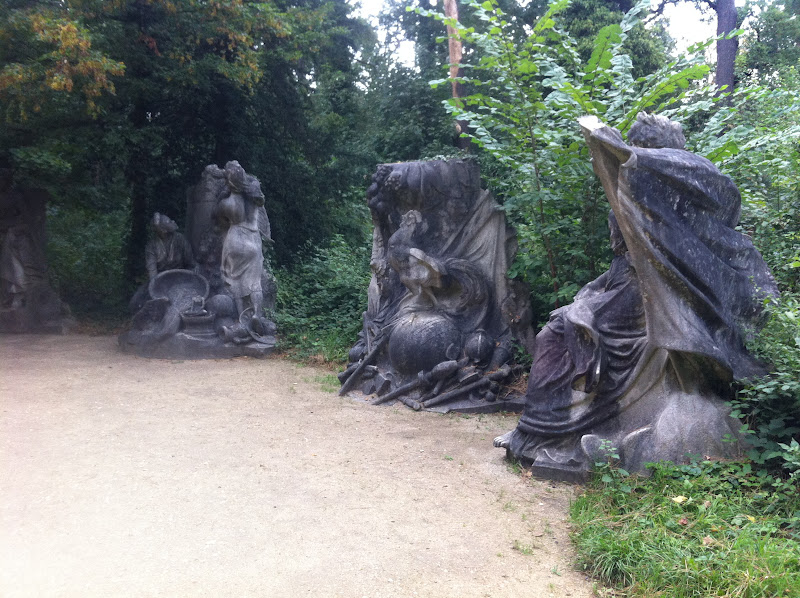
Statues from the 1907 colonial exhibition
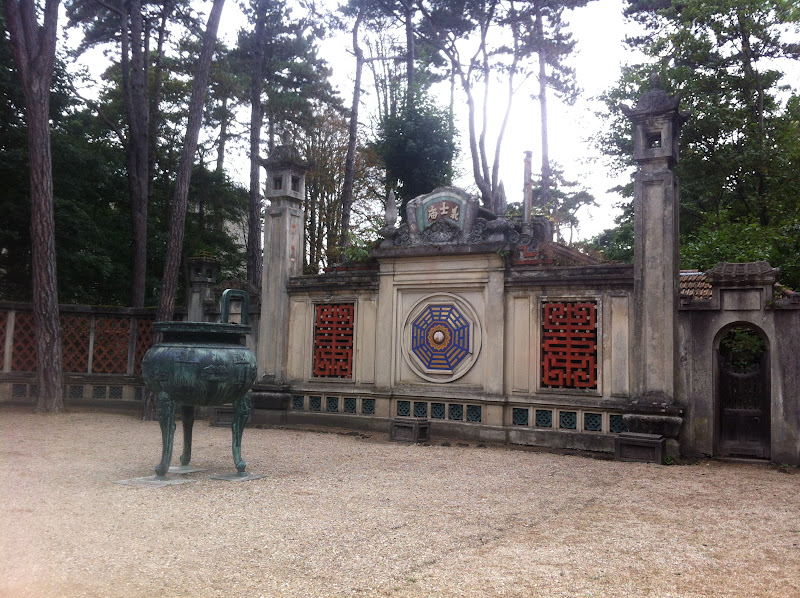
Memories of the Indochinese colony
Many of these statues have seen better days
The garden, at the North-east corner of the Bois de Vincennes has a fascinating history and makes for a unique outing from the busyness of the central Paris.

Dilapidated statues in the park
Originally, in 1899 the park was developed as a test garden for scientific exploration on tropical plants from French colonies. The aim was to improve production of products such as coffee, rubber and banana's.

Some of the old glasshouses

In 1907 the park became the site of the colonial exhibition. Six 'villages' were developed with the monuments representing the French colonies of the time. These were Indochina, Madagascar, Congo, Sudan, Tunisia and Morocco, Not only were monuments and buildings set up, but people from the colonies were bought to Paris to live in the villages, making them a live display, or what has been called a 'human zoo'. RFI France have an interesting article on the 1097 colonial exhibition in English.

Walking through the Jardin

After the exhibition was finished, the park was later used as a hospital for French colonial troops from the first world war, and was the site of the first mosque in Paris. This was removed when the new mosque was built in the 5th arrondisement. Also erected were memorials to the colonial troops who fought and died for France in the war.

Memorial for the troops colonial troops from Cambodia
and Laos who died fighting for France
Memorial for the colonial soldiers from Madagascar
Memorial for the Indochinese who died fighting for France
The park gradually fell into disrepair leaving a desolate, yet amazing collection of memorials and buildings. It is what French historian Pascal Blanchard referred to as "the junkyard of French colonial history....the memory of France's relations to its colonies over the last century is concentrated here".

One of the abandoned pavilions
Another deserted pavilion
However, it is the junkyard feel and overgrown nature of the park which gives it its charm and makes it so unique. Come around a bend in a path and you may come across a Chinese pagoda, or a unique disused building, or a Cambodian temple shaped monument which disappear quickly as you pass, and you are never quite sure what you will discover around the next overgrown corner.

The restored Indochina pavilion
Part of the remains of the Indochina village
Another view of the Indochina village
Recent years has seen money put into the redevelopment of the park. The paths have been cleared and delineated and the dilapidated buildings have been fenced off. The Indochina pavilion has been renovated and is home to the French Institute of Agricultural Research for countries of the South (CIRAD) and also houses an exhibition of photos which appear to be from former French colonial people (it wasn't open when I visited). Other buildings have suffered greatly. The Congo pavilion, for example, was destroyed by fire in 2004. The restoration appears to be ongoing, however running behind schedule. There is also an interesting collection of wooden sculpture which has been set up in the park designed by Johann le Guillerm.

The burnt out Congo Pavilion
One of Johann le Guillerm's sculptures
Another of Johann le Guillerm's sculptures
Johann le Guillerm's incorporated into one of the dilapidated pavilions
Today the park is great for a stroll. It is a surreal experience with the emptiness of the park and the memorials and buildings from different places and different times. Suitable for taking kids; the derelict buildings are fenced off - but there is also water around, so you will need to keep an eye on them. It will probably take you an hour or two to explore the park.

A view across the park 
One of the Indochinese bridges with its pond and waterfall
The garden is Nogent-sur-Marne. While you are there, you could also look at the Pavillon Baltard - Link to come.

How to get there: Take the RER A line to Nogent-sur-Marne. This is in the 3rd zone, so if you are travelling from Paris you will need to buy a specific ticket for this (ie the Paris Metro T+ ticket won't let you out). Take exit #1 from the Nogent-sue_Marne RER station and the direction to the park is well sign-posted from outside the door - follow the signs to Jardin Tropical. It is left from the station, take the first right, and follow this to the end. It is a 5 minute walk from the RER station to the garden.

Exit #1 from the RER
You can see the first sign to the Jardin through the door
For other activities that are off the beaten track and to get a taste of the real France, explore options for day trips from Paris using public transport on www.beyond-paris.com.

Keep up to date with upcoming "off the beaten track" locations, and ideas for day trips from Paris on our Facebook page and our Twitter account.

A final view of the remains of the Indochinese village