Wednesday, 18 June 2014
Monday, 26 May 2014
Thursday, 22 May 2014
Monday, 12 May 2014
Monday, 5 May 2014
Trip Report: Chateau Pierrefonds
We wanted to head down to Blois and rent bikes to ride through the the Loire Valley to visit chateaux.
However, as we were looking to book train tickets down to Blois it was clear that the weather was going to be very average on the weekend. We decided that as much as we were keen to head out biking; we weren't that keen to go biking in the rain. We looked around the country and found that if we headed north the weather was likely to be finer.
One place we have been keen to see for a little while is the chateau/castle at Pierrefonds. However you can't get there by train. So we decided it seemed to be a good opportunity to do our biking, but up north.
We caught an early morning train up to a town called Compiegne. We had called the Compiegne bike rental company beforehand. They normally opened at 2:30, which was a little later than we wanted to start. Thus we called them and asked if they could open early for us. They said they could open at 10:30 for us. Sometimes learning french pays off.
We had to walk to the entrance to the Compiegne Forest. The bike rental people pull up in a van at the forest entrance where you pick up your bike.
We got our bikes and headed off to Pierrefonds. There is a paved cycle path all the way from Compiegne to Pierrefonds. It made a very nice and easy bike ride. Took us about an hour to get there.
Pierrefonds is a nice town. It felt quite wealthy. The weather was coldish and overcast but not too bad. Our first stop was the castle.
The castle was originally built between the 12th century and the 14th century. It was attacked in the early 1600's and was significantly damaged and was abandoned. It wasn't until the late 1800's when the castle was bought by Napoleon III who had it restored in a romantic style.
The castle isn't lavishly decorated alike a Versailles or a Veax de Vicompte but the outside is one of the more impressive castles we have seen. The inside is very spartan. We took our bikes up, there wasn't anywhere to park them but the security guard said we could put them beside the security booth.
We looked around inside for about an hour. We were pretty much the only ones there. The highlights we the chapel (apparently the only chapel with the pulpit above the choir), the collection of statuary from the original chateau, and the collection of plaster casts of funeral statuary. The funeral statuary was made several hundred years ago and were originally at Versailles. They were moved to Pierrefonds for safekeeping where they are now on display.
The chateau closes at around 1. We took the opportunity to bike around the town trying to get a good view of the chateau. We biked up a hill thinking we could get a good view from the top of a hill beside the chateau. Unfortunately there was no access to a good view from the top. We headed down into town to have lunch. There was a lake area where we pulled up the bikes and sat beside the lake for lunch. I had made a Spanish Torte. And we had some other bits and pieces.
Once we had finished lunch we headed back to the chateau to look at a few final things. There were a lot more people at the chateau when we had returned. Partly, I think, because if you were driving from somewhere else in France it would probably take you until the early afternoon to get to Pierrefonds, but more likely because French people really don't do so much in the mornings.
Once we had finished at the chateau we saddled up our bikes and headed back into the forest. We took a turn off the cycle way and headed on the road through to our next stop.
Marshall Foch, in the First World War, chose the forest of Compiegne as the sight for the Germans to sign the armistice. The French arrived in one rail car on one side of the clearing, the German representatives arrived in another car on the other side of the clearing and they met for three days in a separate rail car in the middle of the clearing. Now there are concrete plinths showing where the event happened.
Hitler returned to the clearing when he defeated the French in World War Two and forced the French to sign their surrender in the same rail car, in the same clearing, at the same time of the day as the World War One armistice. They then took the rail car to Berlin where it was eventually destroyed.
Now at the site there is a small (but really interesting) museum. They have built a replica of the rail car which takes pride of place in the museum. They also have a lot of memorabilia from the armistice and WW2.
It was then time to jump in the bikes and head back to Compiegne. We had to navigate through some of the back roads in the forest (including some pretty sandy patches) to get back to the cycle way.
I think we were the first ones to rent bikes that day and we were the last ones back.
We had time to have a snack in Compiegne before we caught the train back to Paris.
However, as we were looking to book train tickets down to Blois it was clear that the weather was going to be very average on the weekend. We decided that as much as we were keen to head out biking; we weren't that keen to go biking in the rain. We looked around the country and found that if we headed north the weather was likely to be finer.
One place we have been keen to see for a little while is the chateau/castle at Pierrefonds. However you can't get there by train. So we decided it seemed to be a good opportunity to do our biking, but up north.
We caught an early morning train up to a town called Compiegne. We had called the Compiegne bike rental company beforehand. They normally opened at 2:30, which was a little later than we wanted to start. Thus we called them and asked if they could open early for us. They said they could open at 10:30 for us. Sometimes learning french pays off.
We had to walk to the entrance to the Compiegne Forest. The bike rental people pull up in a van at the forest entrance where you pick up your bike.
We got our bikes and headed off to Pierrefonds. There is a paved cycle path all the way from Compiegne to Pierrefonds. It made a very nice and easy bike ride. Took us about an hour to get there.
![]() |
| Biking the cycle path to Pierrefonds |
Pierrefonds is a nice town. It felt quite wealthy. The weather was coldish and overcast but not too bad. Our first stop was the castle.
![]() |
| First view of the castle |
![]() |
| View of Pierrefonds across the town square |
![]() |
| Entering the castle |
![]() |
| Inside the courtyard |
![]() |
| Drainpipes |
![]() |
| Statuary |
![]() |
| Inside the castle chapel |
![]() |
| The great hall |
![]() |
| Looking across the courtyard |
![]() |
| A somewhat hard to make out photo of the funeral statuary |
![]() |
| Pierrefonds castle walls |
![]() |
| Looking over Pierrefonds town from the castle |
![]() |
| Last view of Pierrefonds |
Marshall Foch, in the First World War, chose the forest of Compiegne as the sight for the Germans to sign the armistice. The French arrived in one rail car on one side of the clearing, the German representatives arrived in another car on the other side of the clearing and they met for three days in a separate rail car in the middle of the clearing. Now there are concrete plinths showing where the event happened.
![]() |
| Looking across the armistice clearing |
![]() |
| Site of the signing of the armistice |
Now at the site there is a small (but really interesting) museum. They have built a replica of the rail car which takes pride of place in the museum. They also have a lot of memorabilia from the armistice and WW2.
![]() |
| Replica rail car |
We had time to have a snack in Compiegne before we caught the train back to Paris.
Labels:
Chateau,
Compiegne,
Pierrefonds,
Trip report
Monday, 28 April 2014
Where in the world am I? (28 April 14) - with answer
Here is the first photo - where in the world am I this week?
Answer: Chateau de Pierrefonds.
Originally built in the 1600's but it then fell into ruins. It was substantially restored in the 1800's by Napoleon III.
To get there by public transport you should take the train to Compiengne and either bike or walk through the Forest of Compiengne, or take a taxi to Pierrefonds. It is 15km from Compiengne to Pierrefonds and I will put up a trip report with photos of our trip.
Next photo on Monday (Paris time)
Thursday, 24 April 2014
Something new.......
Its been a while since I did much with the blog/twitter account/Facebook page that i created to go along with the website.
Late last year I found full time employment which has limited the time I can spend on updating the website, however we are still travelling around France and around Europe on the weekends and on other holidays. As a result, I have a large number of photographs and corresponding stories of places both on and off the beaten track. I have been wondering what to do with these photos and stories and how I can integrate them into the things i started on beyond-paris.com.
Inspired by something a friend of mine started on her Facebook page, I have decided to start a "where in the world am I?" game.
On Monday, and each Monday, I am going to put up one of my photos from our travels around Europe (and beyond) with the question "where in the world am I?". Then on the Friday I will put up the answer to where the photo was taken and how you can get there (normally using public transport).
I will put the photo up on this blog, and also on my Facebook page (search for us as Beyond Paris), so if you prefer to play on Facebook, feel free to like the page to stay up to date. I will also send it out via Twitter (@beyond_paris).
Monday, 8 July 2013
Photos from Beyond Paris
This photo is of the main hall at the Royal Chateau at Compiegne - about 1 1/2 hours north of Paris.
I'll be adding details of Compiegne, and the nearby Chateau Pierrefonds to the site shortly.
Tuesday, 20 November 2012
Photos from Beyond Paris
The Tour Jeanne d'Arc where Joan of Arc was bought to be threatened with torture in Rouen in 1431.
Tuesday, 13 November 2012
New town added: Blois
Just added a new town to the "Great Towns" section of the website: Blois.
Blois has been one of our favorite towns that we have visited. It is the perfect small French town, just a little off the beaten track - not too touristy, but with enough to see and do.
We dropped down for a weekend, leaving Paris on the Friday night and returning on the Saturday evening. However, the weather didn't co-operate, and we chose a time when many places were shut. We will be heading back next Spring/Summer to explore more.
See http://www.beyond-paris.com/blois.html for details.
Tuesday, 6 November 2012
Photos from Beyond Paris
13th Century Stained glass window from Chartres Cathedral.
Beyond Paris specialises in providing first-hand information and advice on day trips from Paris using public transport. Check out the website at www.beyond-paris.com
Friday, 2 November 2012
Paris off the beaten track: Following Lady Liberty
Paris is full of major must see monuments, sights, and museums. However, hidden within the small side streets of Paris and down some of the less traveled boulevards there are some hidden gems; secret sights that are off the beaten track but are well worth visiting. Not only will they give you some photos of Paris that are different from your friends and family, but they will also give you an insight into the real Paris of today, and the Paris of yesterday.
This weekends off the beaten track in Paris takes in three different locations.
The other week I posted on the work of Gustave Eiffel, noting that one of his major accomplishments was the structural engineering inside the famous Statue of Liberty (which was of course conceived and designed Frederick Bartholdi) in New York. No one, even those not of American heritage, can help but be moved at the poignant symbolism of this major global landmark
Paris' link with the famous statue is a strong one, and long felt. The original statue was designed and constructed in Paris . While I haven't managed to track down exactly where the statue was constructed, there have been a number of photos uncovered of the statue being built in Paris. Where ever it was, it would have been amazing to have seen it being built. The head and the arm holding the flame were displayed at different events in Paris during their construction.
Today there are a number of reminders of the link between France, and especially Paris, and the Statue of Liberty. Today's post visits three of them.
The first stop is on the border of the 16th and 15th arrondissements. If you have taken the RER to Versailles and been facing backwards, and looked out the window at just the right time, you may have had a "what the...." moment as very quickly a miniature version of the Statue of Liberty standing on an island in the middle of the Seine flashes by.

The island is called Ile aux Cygnes (island of swans). The scale model is 11.5m/37ft9in tall and the book in Lady Liberty's hand carries the inscription "IV Julliet 1776 = XIV Julliet 1789" which equates "Bastille Day" with American Independence Day. The statue was given to the people of France by the "American Community of Paris" to commemorate the centenary of the French Revolution. It was inaugurated by French President Carnot on the 14th of July 1889, three years after the inauguration of the New York statue.

To get to Ile aux Cygnes either take the RER C line to Champ de Mars or the 6 line to Bir Hakeim and walk along the Seine away from the Eiffel Tower. The other option is the 10 line to Javel Andre Citron.
If you want to do a trip across Paris and visit all three sights, from here you can catch the RER C line heading into Paris. Get off at Alma Marceau. Cross the Seine to find the second link between Paris and the New York icon.

Standing on top of the Pont de l'Alma underpass is a full-sized replica of the Statue of Liberty's flame. Called "The Flame of Liberty" the statue was a gift to the people of Paris by the International Herald Tribune newspaper. It celebrated the 100th anniversary of the publishing of an English-language newspaper in France and was also, at the same time, a token of thanks for the work undertaken by France in the restoration of the the New York Statue of Liberty.

The Flame of Liberty was inaugurated by Jacques Chirac in 1989. In 1997 Diana, Princess of Wales died in a car crash in the Pont de l'Ama tunnel and the Flame monument has since become a memorial to the life and death of Diana with people often leaving flowers, pictures, letters, poems, and, on the anniversary of her death, sometimes candles in her memory.
'
For the next stop, jump back on the RER C line, in the same direction as before (towards Invalides) and change to the RER A line at St-Michel Notre-Dame. Hop off the RER at Luxembourg. Exit the RER station using exit number 1. At the top of the stairs is the Jardin du Luxembourg, one of Paris' major parks and home to the French Senate (there is also a pretty good ice cream stand as well!). Enter the gardens and go straight ahead in to the middle of the garden. As you come to the lake in the the middle of the Garden, go around the lake to the left and when you reach the other side, turn left again along the side of the garden and take the first set of stairs on your right. Go up the stairs and head straight down the tree lined alley.

At the end of the alley is what could be called the original Statue of Liberty. The scale model in bronze was apparently part of the preparation works for the larger statue in New York. Bartholdi gave the statue as part of the Universal Exhibition in 1900 and was moved to the Luxembourg Gardens in 1906.

This statue has inscribed on its book "IV Julliet 1889" the date of the inauguration of the larger Parisian statue (on Ile aux Cygnes). This statue is one of many in the park, and if you haven't visited the Luxembourg Gardens, they are a great place to visit on a nice day.
Also of note, right next door to the Statue of Liberty, is an American Oak tree planted to remember those who died in the September 11 2001 attacks.
If you want to complete your tour of Statue of Liberty items in Paris, you should visit the Musee des Arts et Metiers at 60 Rue Reaumur in the 3rd arrondissement Inside the medieval abbey church of St-Martin-des-Champs is a scale model at 1/16 the size of the original, and two models of the construction of the actual statue. I haven't had a chance to get to this museum yet, but as soon as I do, I will update this post with photos from my visit.
For other activities that are off the beaten track and to get a taste of the real France, explore options for day trips from Paris using public transport on www.beyond-paris.com.
Keep up to date with upcoming "off the beaten track" locations, and ideas for day trips from Paris on our Facebook page and our Twitter account.
This weekends off the beaten track in Paris takes in three different locations.
The other week I posted on the work of Gustave Eiffel, noting that one of his major accomplishments was the structural engineering inside the famous Statue of Liberty (which was of course conceived and designed Frederick Bartholdi) in New York. No one, even those not of American heritage, can help but be moved at the poignant symbolism of this major global landmark
Paris' link with the famous statue is a strong one, and long felt. The original statue was designed and constructed in Paris . While I haven't managed to track down exactly where the statue was constructed, there have been a number of photos uncovered of the statue being built in Paris. Where ever it was, it would have been amazing to have seen it being built. The head and the arm holding the flame were displayed at different events in Paris during their construction.
Today there are a number of reminders of the link between France, and especially Paris, and the Statue of Liberty. Today's post visits three of them.
The first stop is on the border of the 16th and 15th arrondissements. If you have taken the RER to Versailles and been facing backwards, and looked out the window at just the right time, you may have had a "what the...." moment as very quickly a miniature version of the Statue of Liberty standing on an island in the middle of the Seine flashes by.

The island is called Ile aux Cygnes (island of swans). The scale model is 11.5m/37ft9in tall and the book in Lady Liberty's hand carries the inscription "IV Julliet 1776 = XIV Julliet 1789" which equates "Bastille Day" with American Independence Day. The statue was given to the people of France by the "American Community of Paris" to commemorate the centenary of the French Revolution. It was inaugurated by French President Carnot on the 14th of July 1889, three years after the inauguration of the New York statue.

To get to Ile aux Cygnes either take the RER C line to Champ de Mars or the 6 line to Bir Hakeim and walk along the Seine away from the Eiffel Tower. The other option is the 10 line to Javel Andre Citron.
If you want to do a trip across Paris and visit all three sights, from here you can catch the RER C line heading into Paris. Get off at Alma Marceau. Cross the Seine to find the second link between Paris and the New York icon.

Standing on top of the Pont de l'Alma underpass is a full-sized replica of the Statue of Liberty's flame. Called "The Flame of Liberty" the statue was a gift to the people of Paris by the International Herald Tribune newspaper. It celebrated the 100th anniversary of the publishing of an English-language newspaper in France and was also, at the same time, a token of thanks for the work undertaken by France in the restoration of the the New York Statue of Liberty.

The Flame of Liberty was inaugurated by Jacques Chirac in 1989. In 1997 Diana, Princess of Wales died in a car crash in the Pont de l'Ama tunnel and the Flame monument has since become a memorial to the life and death of Diana with people often leaving flowers, pictures, letters, poems, and, on the anniversary of her death, sometimes candles in her memory.
'
For the next stop, jump back on the RER C line, in the same direction as before (towards Invalides) and change to the RER A line at St-Michel Notre-Dame. Hop off the RER at Luxembourg. Exit the RER station using exit number 1. At the top of the stairs is the Jardin du Luxembourg, one of Paris' major parks and home to the French Senate (there is also a pretty good ice cream stand as well!). Enter the gardens and go straight ahead in to the middle of the garden. As you come to the lake in the the middle of the Garden, go around the lake to the left and when you reach the other side, turn left again along the side of the garden and take the first set of stairs on your right. Go up the stairs and head straight down the tree lined alley.

At the end of the alley is what could be called the original Statue of Liberty. The scale model in bronze was apparently part of the preparation works for the larger statue in New York. Bartholdi gave the statue as part of the Universal Exhibition in 1900 and was moved to the Luxembourg Gardens in 1906.

This statue has inscribed on its book "IV Julliet 1889" the date of the inauguration of the larger Parisian statue (on Ile aux Cygnes). This statue is one of many in the park, and if you haven't visited the Luxembourg Gardens, they are a great place to visit on a nice day.
Also of note, right next door to the Statue of Liberty, is an American Oak tree planted to remember those who died in the September 11 2001 attacks.
If you want to complete your tour of Statue of Liberty items in Paris, you should visit the Musee des Arts et Metiers at 60 Rue Reaumur in the 3rd arrondissement Inside the medieval abbey church of St-Martin-des-Champs is a scale model at 1/16 the size of the original, and two models of the construction of the actual statue. I haven't had a chance to get to this museum yet, but as soon as I do, I will update this post with photos from my visit.
![]() |
For other activities that are off the beaten track and to get a taste of the real France, explore options for day trips from Paris using public transport on www.beyond-paris.com.
Labels:
15th arrondissement,
16th arrondissement,
5th arrondissement,
8th arrondissement,
Off the beaten track
Monday, 29 October 2012
Trip Report: Fontainebleau
This is our trip report from Fontainebleau. We went a little while ago, as you will be able to tell from the photos - the weather was much nicer when we went down than it has been recently. We had tried to make it to Fontainebleau three times before, but for various reasons we never quite made it down. Finally we made it down. We only knew three things about Fontainebleau:
1) It has a famous chateau
2) The town is reportedly well worth seeing.
3) It has a famous forest where the kings used to hunt.
So again, we took the train out of Paris (from a new station this time: Gare de Lyon) to Fontainebleau. Train travel is getting much easier to manage.
We arrived in Fontainebleau at around lunchtime, and scorning the bus (which was packed with tourists) decided to walk the 4 kilometres to the Chateau, thereby seeing the purportedly cute town on the way:
The Chateau is similar to the others we've seen in that it has an open U shaped forecourt, with the entrance at the "bottom" of the U, but
The rooms inside are as ornate as Versailles, but somehow manage to feel more homely, and less ostentatious.
Key differences from Versailles:
1) Many of the original furnishings are still at Fontainebleau;
2) There's no consistent theme to the rooms' decor, or even their layout - many of them represent different periods in the royal history of France;
3) The ceilings are way cooler- lots of different geometric patterns and decoration styles;
4) There are many walls entirely covered in amazing tapestries;
5) The walls are also decorated with sculptures as well as paintings.
For example- the tapestries and other furnishings:
One of the cool ceilings:
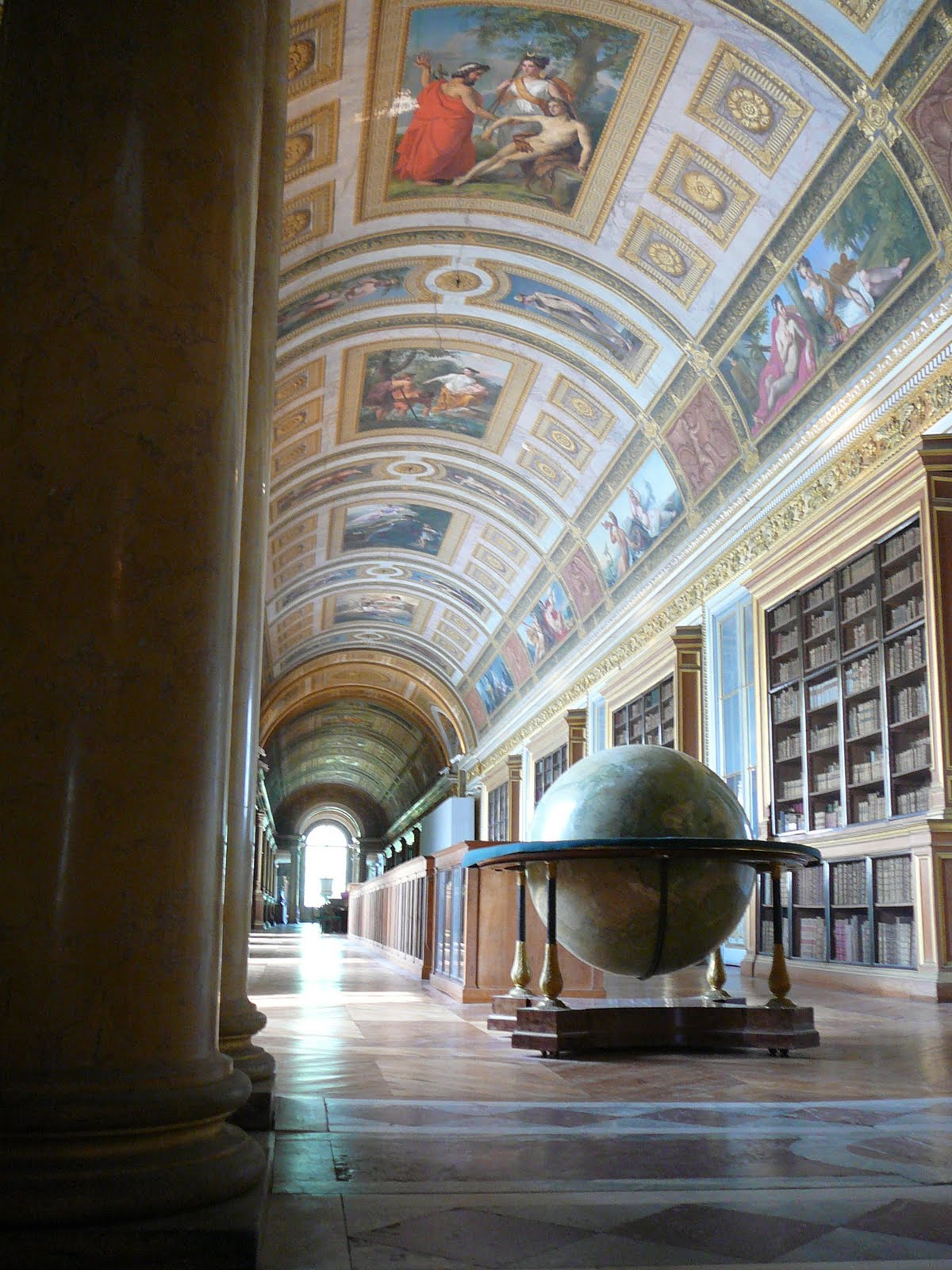
The amazing library:
Another tapestry and furniture inside the Chateau:
The King's bedroom:
The roof of one of the staircases:
The chapel inside the Chateau:
Fontainebleau also has formal gardens - the largest in France. Again, these are less coherent than Versailles, but also more charming, but also designed by Andre le Notre. This is the view back over one of the lakes to the side of the palace:
One of the main lakes, with a summerhouse set on the lake, and the chateau in the background:
Another view of the formal gardens, with Fontainebleau's Grand Canal (much less grand than Versailles's: about 1/5 of the length, less than 1/2 the width, and without the cross bar) in the distance. We ate lunch by the right hand side of the Grand Canal in this photo but got chased away by swarms of midgets who liked our apples.
After lunch (at about 4 o'clock!) and some roaming around the gardens, we saw a little path leading as far into the distance as we could see. It went into the forest. Knowing that the forest was also famous, we decided to follow the path. This is about halfway down; you can see there's a hill at the far end:
In yesterday's photos there were some shots looking back from the top of the hotel toward the chateau. This photo is on that same line, but within the grounds of the chateau (about 2 kilometres from that hill).
We climbed up the hill, and took this photo looking back over the Chateau. If you follow the line as far as you can, the Chateau is there:
A photo from the same location, but zoomed so you can just identify the Chateau above the trees:
Another view from the top of the hill, this time over the countryside and forest:
Part of the walk to get there- nice to have something approaching a bushwalk!
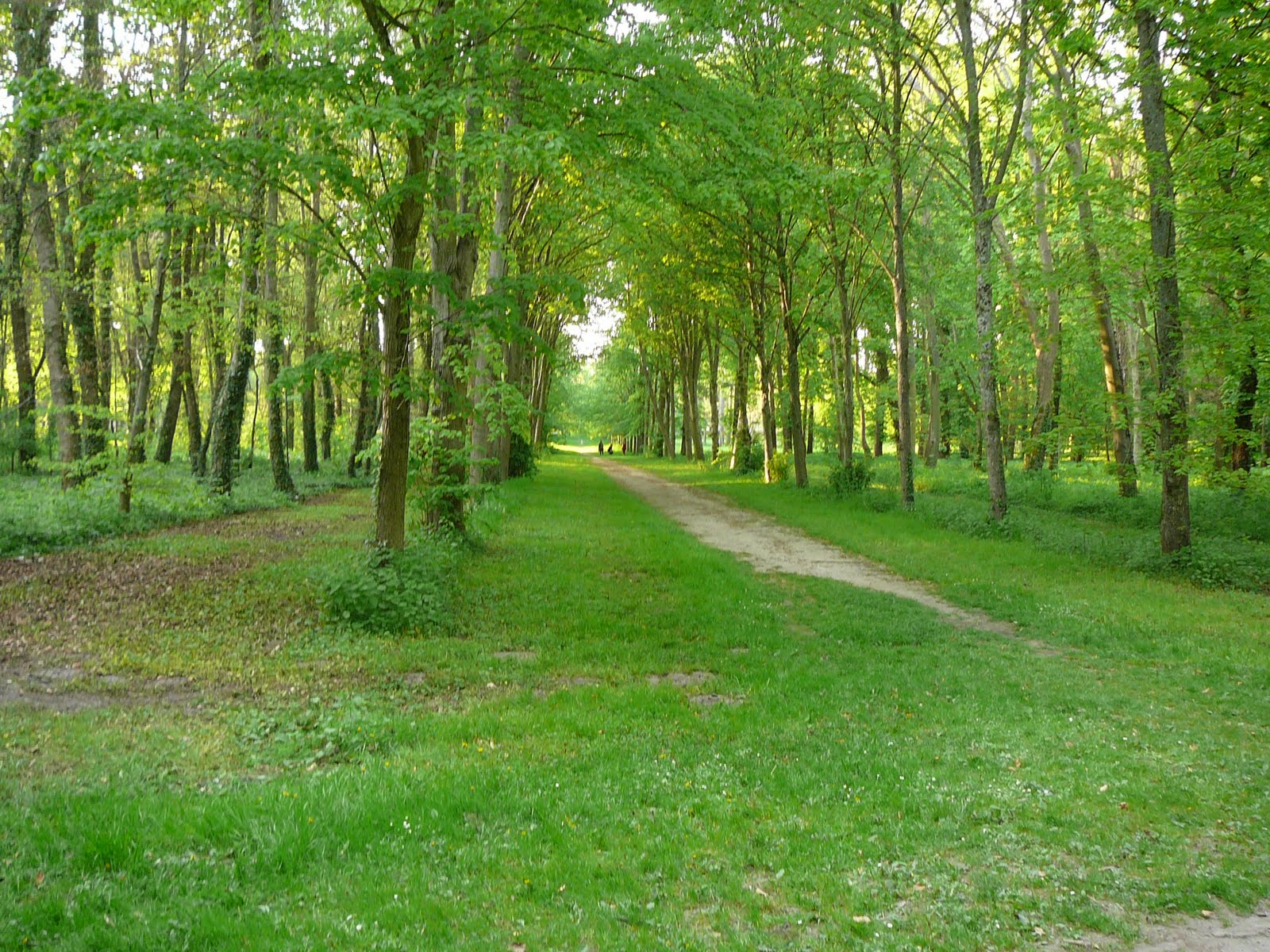
We explored through the forest for a bit, and then decided to walk the approximately 6 kilometres back to the train. Once we were out of the track in the previous photos, we cut through the park at Fontainebleau. It was very beautiful- so much greenery! This is one of the glades we walked through.
Returning through the glades at the end of the day, we caught this glimpse of the chateau through the trees:
1) It has a famous chateau
2) The town is reportedly well worth seeing.
3) It has a famous forest where the kings used to hunt.
So again, we took the train out of Paris (from a new station this time: Gare de Lyon) to Fontainebleau. Train travel is getting much easier to manage.
We arrived in Fontainebleau at around lunchtime, and scorning the bus (which was packed with tourists) decided to walk the 4 kilometres to the Chateau, thereby seeing the purportedly cute town on the way:
The Chateau is similar to the others we've seen in that it has an open U shaped forecourt, with the entrance at the "bottom" of the U, but
1) Many of the original furnishings are still at Fontainebleau;
2) There's no consistent theme to the rooms' decor, or even their layout - many of them represent different periods in the royal history of France;
3) The ceilings are way cooler- lots of different geometric patterns and decoration styles;
4) There are many walls entirely covered in amazing tapestries;
5) The walls are also decorated with sculptures as well as paintings.
For example- the tapestries and other furnishings:
One of the cool ceilings:
The amazing library:
Another tapestry and furniture inside the Chateau:
The King's bedroom:
The roof of one of the staircases:
The chapel inside the Chateau:
Fontainebleau also has formal gardens - the largest in France. Again, these are less coherent than Versailles, but also more charming, but also designed by Andre le Notre. This is the view back over one of the lakes to the side of the palace:
One of the main lakes, with a summerhouse set on the lake, and the chateau in the background:
Another view of the formal gardens, with Fontainebleau's Grand Canal (much less grand than Versailles's: about 1/5 of the length, less than 1/2 the width, and without the cross bar) in the distance. We ate lunch by the right hand side of the Grand Canal in this photo but got chased away by swarms of midgets who liked our apples.
After lunch (at about 4 o'clock!) and some roaming around the gardens, we saw a little path leading as far into the distance as we could see. It went into the forest. Knowing that the forest was also famous, we decided to follow the path. This is about halfway down; you can see there's a hill at the far end:
In yesterday's photos there were some shots looking back from the top of the hotel toward the chateau. This photo is on that same line, but within the grounds of the chateau (about 2 kilometres from that hill).
We climbed up the hill, and took this photo looking back over the Chateau. If you follow the line as far as you can, the Chateau is there:
A photo from the same location, but zoomed so you can just identify the Chateau above the trees:
Another view from the top of the hill, this time over the countryside and forest:
Part of the walk to get there- nice to have something approaching a bushwalk!
We explored through the forest for a bit, and then decided to walk the approximately 6 kilometres back to the train. Once we were out of the track in the previous photos, we cut through the park at Fontainebleau. It was very beautiful- so much greenery! This is one of the glades we walked through.
We arrived at the train station just a few minutes before the next train, and arrived back in Paris about 10 pm. Another very good day.
Subscribe to:
Posts (Atom)